
Arrowsmith - Part 2
Exploring the Laureates - The Pulitzers

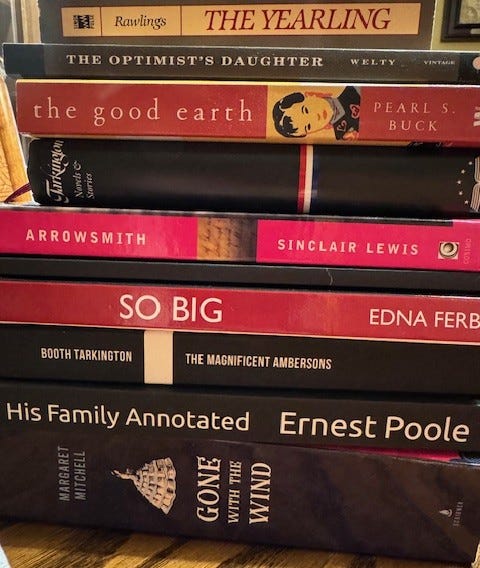
Week Two of Sinclair Lewis’s 1926 Pulitzer Award Winning Novel Arrowsmith. Don’t forget to hit the heart button if you think any of this work has been worth your time.
Notes:
Reading Arrowsmith took a little while. It did not capture my attention with either the dialogue or the plot. But the novel is, nonetheless, a Pulitzer prize winner, and the author was the first American to win the Nobel prize for literature. Surely there was something of value here.
As I mentioned in Part One, parts of the novel connected me to the medical television shows that I have been fascinated with most of my adult life. The doctors’ obsessions with the medicine and the (usually) happy ending of the show made for a decent hour of entertainment. But for me, the characters of House, er, Gray’s Anatomy, and even General Hospital had more depth than the characters of Arrowsmith.
The research on the novel sucked me in to the academic debate on Lewis. Some of the theories I read considered him a writer who was not afraid to paint an honest picture of the real America. In fact, more than one writer suggested that Lewis was awarded the Nobel because his works painted an unflattering portrait on America. Perhaps that is why many critics believe he should be studied. Schorer states,
“His twenty-two novels, so uneven in quality, do share in one likeness: they are a long march all directed toward a single discovery, the ‘reality’ of America. This aim was Lewis’ inheritance as a novelist who was formed in the second decade of this century, when the discovery of the ‘real’ America, an America beyond the chauvinistic nonsense and the merely sentimental optimism that had formed the image of an earlier generation, became the aim of nearly every writer who took himself seriously.”
Whether they liked him or not, and whether we like him or not, Lewis did dig the trenches for novels (and later TV shows) to look more honestly at the American reality. For that, he is worthy of study.
Academic Helpers:
If you can find a copy of the movie, consider a comparison of the novel and the film. You might also compare two of Lewis’s works, such as Main Street and Arrowsmith, which were both considered for the Pulitzer.
Research the medical field prior to 1920, and write an essay on Lewis’s satirical examination in Arrowsmith of the commercialization of science.
Write an essay on Martin Arrowsmith as hero or Martin Arrowsmith as villain.
There is quite a bit of drama in the history of Lewis and de Kruif. Write a play about their friendship, writing partnership, and downfall.
Is it worth the eye strain?
I cannot imagine providing a full summary for this novel.
Lewis twists and turns the life of Martin Arrowsmith so often that I had to reread earlier chapters to understand what was happening. It was not a pleasant experience.
What strikes me as unusual about the novel is that I cannot decide whether Martin is a hero or a villain in any area of his life. To be honest, I can’t even decide whether he is a three-dimensional character. So, rather than taking you on a chronological journey through the novel, it might be easier on both of us to take a look at some of the decisions and mistakes that Martin makes in regards to women. Maybe you can decide whether he should be remembered or studied as a literary character.
While Martin is a medical student, he makes one of his first mistakes. He proposes marriage to Madeline Fox, a young woman who studies English and wants to avoid going home to a small town to live with her mother. After she tells him of her fear, she bursts into tears, prompting Martin to say,
“Darling! I almost feel as if I dared to love you. You’re going to marry me and — Take me couple more years to finish my medical course and couple in hospital, then we’ll be married and — By thunder, with you helping me, I’m going to climb to the top. Be big surgeon! We’re going to have everything!” (p. 28).
First, I have to admit that I laughed at this. I don’t even believe him here. He acts convinced about an action at the same time knowing that it isn’t possible. But he does try to save the damsel in distress, initiating the Martin-hero mode.
Of course, he doesn’t stay hero for long. On an errand at a hospital for his mentor, Gottlieb, Martin randomly meets Leora Tozer, a nurse trainee. He’s rude and snobby to her, and she insults him. Because he can’t let it go, he looks for her in the hospital in order to chastise her, finding that they were both showing off. They strike up a conversation, which Lewis describes,
“And as natural, as conventional, as youthfully gauche … was the talk of Martin and Leora in that passionate half-hour when each found in the other a part of his own self, always vaguely missed, discovered now with astonished joy. They rattled like hero and heroine of a sticky tale, like sweat-shop operatives, like bouncing rustics, like prince and princess. Their words were silly and inconsequential, heard one by one, yet taken together they were as wise and important as the tides or the sounding wind” (p. 33).
Martin immediately asks Leora to dinner. He does have a moment of guilt thinking about Madeline and considers cancelling the date. Instead, he arrives early to pick up Leora. He avoids seeing much of Madeline in the next two weeks, has two dinner dates with Leora during those two weeks, and proposes to her at the end of the second date.
After Martin discovers he hasn’t the nerve to break up with Madeline, he moves on to his next solution - drinking with his friend, Clif Clawson. During the whiskey, Martin has an epiphany.
“He had it! He would invite Leora and Madeline to lunch together, tell them the truth, and see which of them loved him. He whooped, and had another whiskey … unsteadily he retired to the telephone, which was shut off from public hearing in a closet” (p. 37).
The only compensation Lewis awards the reader for the behavior of his boorish lead character is that Martin has a terrible hangover in the morning when he must meet these women for lunch.
The lunch scene is one of the better pieces of the novel, so I won’t spoil it for you. But I do want to note the small paragraph that pushed my buttons a bit with Martin. As Martin and Madeline arrive at the Grand Hotel and meet Leora in the lobby, Martin turns a critical eye on Leora’s clothing.
“Martin perceived that Leora was unusually sloppy — his own word. It did not matter to him how clumsily her honey-colored hair was tucked under her black hat, a characterless little mushroom of a hat, but he did see and resent the contrast between her shirtwaist, with the third button missing, her checked skirt, her unfortunate bright brown bolero jacket, and Madeline’s sleekness of blue serge. The resentment was not toward Leora. Scanning them together (not haughtily, as the choosing and lofty male, but anxiously) he was more irritated than ever by Madeline. That she should be better dressed was an affront. His affection flew to guard Leora, to wrap and protect her” (p. 40).
While that last line might encourage the reader to consider hero mode again, this is not the only time in the novel that Martin takes inventory of Leora’s clothes and appearance. At one point, during their marriage, he tells her off about not looking as fashionable as she should when they are going to have dinner with some fancy friends. (Insert angry face emoji here.) For me, Martin enters (and really never leaves) the lousy husband villain mode.
But, yes, they get married, and they move to live near her family in Wheatsylvania. For a time, Martin practices as a country doctor. Not successful, they move again to Nautilus as he takes a job as a public health doctor working for Dr. Pickerbaugh.
Without stepping outside of the review of Martin’s decisions, I have to say that it is the character of Dr. Pickerbaugh that makes me want to read more Lewis. Much of what I read prior to the novel said that Lewis was a satirist. I most definitely found the satire in Dr. Pickerbaugh. Martin finds it, too, during his first meeting with the eminent doctor as he reviews Dr. Pickerbaugh’s scrapbook:
“The articles and editorials regarding him, in newspapers, house organs, and one rubber-goods periodical, were accompanied by photographs of himself, his buxom wife, and his eight bounding daughters, depicted in Canadian winter costumes among snow and icicles, in modest but easy athletic costumes, playing tennis in the backyard, and in costumes of no know genus whatever, frying bacon against a background of Northern Minnesota pines.
Martin felt strongly that he would like to get away and recover … He realized that to a civilized man the fact that Pickerbaugh advocated any reform would be sufficient reason for ignoring it” (p. 119)
Once again, Martin disappoints us as he develops a crush on Pickerbaugh’s oldest daughter, Orchid. Leora warns him the first night that he meets Orchid that she can see his interest. But, of course, he continues the flirtation with Orchid, finally kissing her when Leora is out of town. Stupid, stupid Martin. He walks away from this mistake after he realizes that Leora is a “brainless man-chaser” (p. 142).
After the ridiculous moves with Orchid, Martin leaves Nautilus and Dr. Pickerbaugh for a job in Chicago working with a former competitive classmate. The job at the Rouncefield Clinic with Angus Duer pushes Martin into uncomfortable social circles, and the lousy husband resurfaces. After a party, he berates Leora:
“Good God, couldn’t you even take the trouble to notice you had a spot of soot on your nose tonight? Mrs. Duer noticed it, all right! Why are you so sloppy?Why can’t you take a little care? And why can’t you make an effort, anyway, to have something to say? You just sit there at dinner — you just sit and look healthy! Don’t you want to help me? Mrs. Duer will probably help Angus to become president of the American Medical Association, in about twenty years, and by that time I suppose you’ll have me back in Dakota as assistant to Hesselink!” (p. 165)
After Leora explains that she had tried to look nice and had studied an art book so that she would have something to talk about, Martin sobs with guilt. With Leora, his whine - berate - apologize pattern comes from his own insecurity and from his unhappiness in his job. Along comes Max Gottlieb (introduced early in the novel as Martin’s mentor). Gottlieb offers Martin a job in at the prestigious McGurk Institute, so the Arrowsmith’s move to New York.
Martin has a breakthrough in his work, discovering a bacteriophage that could cure pneumonia and plague. During the hours of work, Leora is by his side, supporting and encouraging him. The setting shifts as the novel takes us into the world of St. Hubert - an island full of plague. Martin is asked to take his bacteriophage and conduct an experiment on the island. Dedicated to the discovery of whether his treatment will work, Martin agrees to go to the island and Leora goes with him.
Lewis introduces us to a different world in St. Hubert with a host of new characters. The tone of the novel shifts as Martin becomes more serious. His interaction with the St. Hubert citizens makes Martin a much more interesting character - at least for a bit.
***Spoiler alert ***
Martin is eventually appointed as a medical officer with complete power who must move to a different area of the island. He refuses to take Leora believing her to be much safer at their original home. Naturally, Martin meets a beautiful, wealthy widow, Joyce Lanyon, at the new home. And, naturally, Martin becomes enamored of her, kissing her and holding her hand and forcing himself to stay away from her bedroom.
He makes the decision to have Leora join him at the new house, but he arrives too late. Leora has died from plague.
“He talked to her, his voice a little insane, trying to make her understand that he had loved her and had left her here only for her safety —
There was rum in the kitchen, and he went out to gulp down raw full glasses. They did not affect him.
By evening he strode to the garden, the high and windy garden looking toward the sea, and dug a deep pit. He lifted her light stiff body, kissed it, and laid it in the pit. All night he wandered. When he came back to the house and saw the row of her little dresses with the lines of her soft body in them, he was terrified.
Then he went to pieces” (p. 237).
Martin goes through a period of heavy drinking, abandoning his experiment. He gives the phage to everyone that will take it and saves the remaining citizens of St. Hubert. Hero? He doesn’t even know:
“The more they shouted his glory, the more he thought about what unknown, tight-minded scientists in distant laboratories would say of a man who had had his chance and cast it away. The more they called him the giver of life, the more he felt himself disgraced and a traitor…” (p. 240).
As Lewis rushes the reader towards the end of Arrowsmith, we get ends to several character stories. Martin returns to the institute as the Director of Microbiology, working with his old friend Terry Wickett. He eventually dates and marries Joyce Lanyon. But the moon-eyed, rash Martin seems gone:
“What Martin felt for Joyce was what any widowed man of thirty-eight would feel for a young and pretty and well-spoken woman who was attentive to his wisdom. As to her wealth, there was no problem at all. He was no poor man marrying money! Why, he was making ten thousand a year, which was eight thousand more than he needed to live on!” (p. 249)
This marriage brings fatherhood and potential career success to Martin. But he realizes quickly that his scientific work is what matters to him. He leaves Joyce and moves in with Terry in the country to work. She begs him to allow her to build a house near them and reconcile. In their last conversation, he tells her,
“Joyce, I do love you. I want awfully, just now, to kiss you properly … But you want a playmate, and I want to work. I’m afraid you can’t stay. No” (p. 270-71).
For the first time, Martin the man stays true to himself. He may not be the hero husband that we want him to be, but he is also not a villain. At this point, he also seems three dimensional, even if it is a bit late in the novel.
Arrowsmith wants to be many things with the exception of a character study. It’s a busy story that takes the reader through a partially wasted life where the main character only receives one moment of clarity. Realistic - no. But the central question of living a heroic life is one worth examining.
Even if you only want to understand why so many of our TV doctors seem similar, Arrowsmith is worthwhile reading. But only just the once. Other than that, it’s not worth the eye strain.
Sources:
Lewis, Sinclair. Arrowsmith. Cosimo Classics. 2021.
Helleberg, Marilyn Morgan. “The Paper-Doll Characters of Sinclair Lewis’ Arrowsmith.” Mark Twain Journal, Summer, 1968, Vol. 14, No. 2.
Lynch, Lisa L. “Arrowsmith Goes Native: Medicine and Empire in Fiction and Film.” An Interdisciplinary Critical Journal, December 2000, Vol. 33, No. 4, a special issue.